

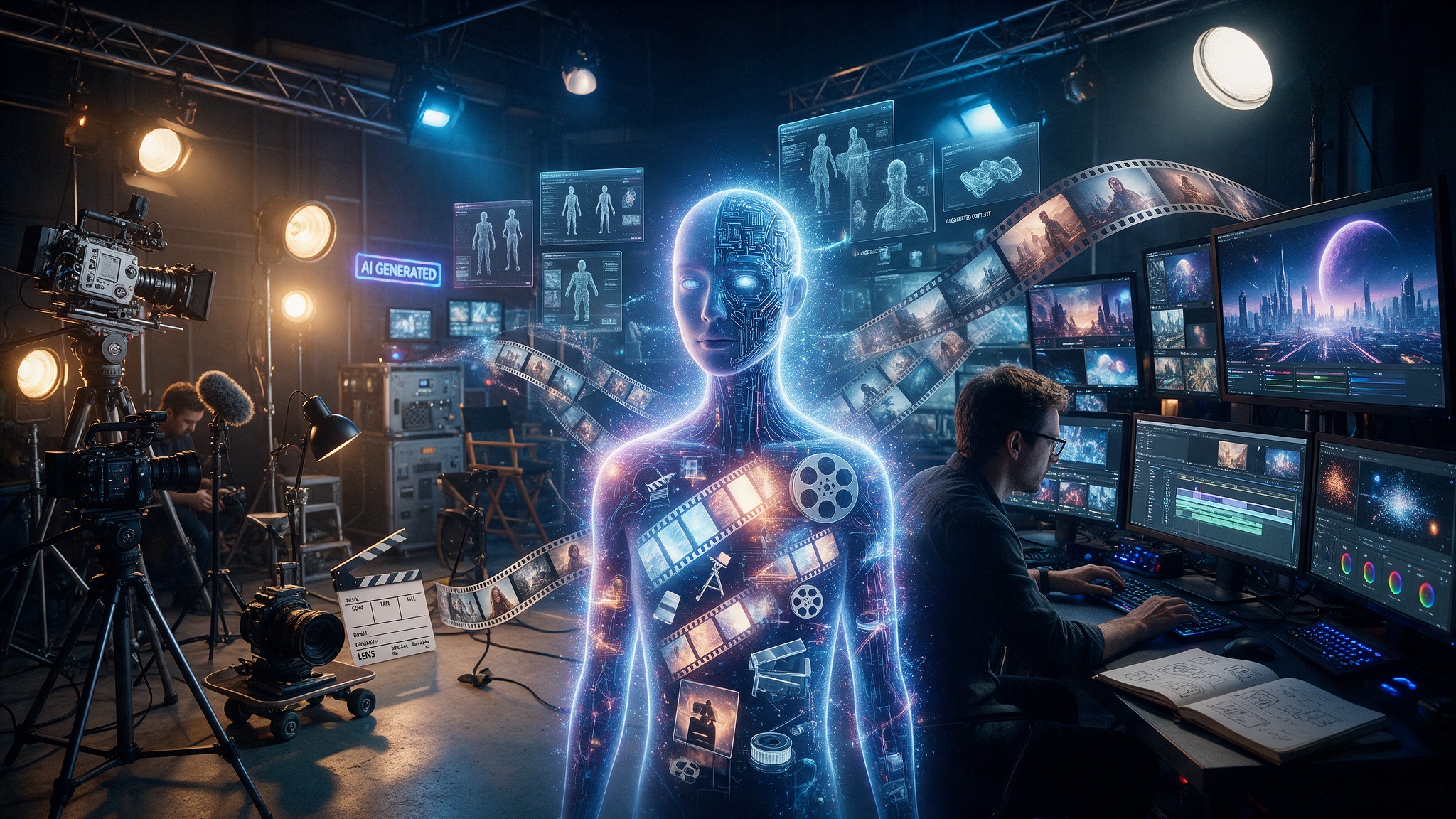
The first wave of AI made enterprises efficient. The next wave will make a billion Indians creators. The companies that win it will not be the ones with the biggest models. They will be the ones people trust with their voice, their face and their culture.
Most
of the AI industry is teaching machines to talk, to listen, or to see. Agents
hold customer conversations, voice systems answer the phone, and cameras watch
the road. They are useful and valuable, and the efficiency they bring is
reshaping every enterprise.
Efficiency
will change how India works. The more consequential project is teaching
machines to tell stories, and to ask permission first. This will change who in
India gets to create, and I believe that is the larger shift.
Vibe coding has a creative twin
When
vibe coding entered the vocabulary in 2025, it named something founders had
already felt. You describe what you want, the machine writes the code, you
react, it rewrites, and a working product exists by evening. The engineer did
not disappear. The requirement to be one did.
The
same phenomenon is underway in entertainment, and it deserves its own name:
vibe creating. The camera, the edit suite, the composer and the dubbing studio
once needed capital, crew and years of apprenticeship. All of them are folding
into a phone. In under two years, text-to-video has gone from research demo to
consumer product, and what took a full crew and a week now takes a prompt and
an afternoon. India never lacked creative talent. It lacked access to the tools
of production. Remove that barrier and the bottleneck moves from skill to
imagination. For the first time, the only thing standing between a story and
its audience is whether someone can imagine it.
When average is free, taste is the price
If
almost anyone can generate sophisticated content on demand, what separates a
creator from someone who simply knows how to use the machine? For several
decades, creative industries hired for execution. AI now executes. What remains
is taste, judgment, and direction. Taste is knowing what ‘good’ looks like
before it exists. Judgment is saying ‘no’ to the average output AI produces in
abundance. Direction is holding a vision steady while a dozen tools pull
towards the mean. Imagination starts a story. Taste decides whether it is worth
finishing.
The
best creative people I have worked with were never the fastest operators. They
were the ones who could say no. Every professional is becoming a director of
agents, tools, and outcomes. Editors become story architects, and marketers
design experiments rather than posters. The craft has not lost value. It has
moved up a level. AI has made average free. The only thing left to pay for is
taste.
Agents will run the studio floor; humans will own the story
In a
studio, the autonomous agent is not the future of work. It is already working the
night shift. Agents now draft the dubbing, pass the subtitles, tag the scenes,
run first-pass moderation and test campaigns around the clock, without human
intervention. None of that was ever where the value lay.
After
two decades of building media platforms, I have stopped asking which jobs AI
will take and started asking which decisions it must never be allowed to make.
What agents will not own is the story, the rights, and the final call. The
fashionable phrase is that humans will move up the stack to supervise. That is
too small a job. Supervision checks the machine’s work. Ownership decides what
deserves to exist and answers for it when it does. The human role in an
AI-native studio is authorship, with accountability woven into it.
Rights before renders
AI
makes provenance and ownership more important precisely because creation has
become easy. When a scene can be generated in minutes, value shifts from the
render to the right to render. The AI models that generate text, images, and
video are becoming a commodity. Several companies build them and compete
aggressively on performance and price, with one another and with open-source
models that are free. Cleared intellectual property in a film, a song or a
star’s likeness is not a commodity. It is owned. The companies that build the
models do not own the films, music and characters a culture grew up on, the
rights to adapt them, or the permission of a late star’s family to bring that
star back to the screen. All these rights belong to studios, artists and their
estates.
So
the operating rule for AI in entertainment has to be rights before renders. No
adaptation without cleared rights. A traceable origin on every output.
Screening with hard blocks on non-consensual likeness, and a published route to
redress when something goes wrong. Consent, provenance, moderation and
accountability are not a compliance slide. They are the licence to operate. I
would go further. In the age of the render, consent is the new copyright. It is
also the better business. A voice artist whose voice is licensed, labelled and
paid every time it is used has not lost a job to AI. That artist has gained a
royalty engine.
Language gets you in the door; culture makes you stay
There
is one more condition for vibe creating to work in India, and it applies to
every market where people live in more than one language. India does not merely
speak in many languages. We think, persuade, joke, and grieve differently across
them. Translation is table stakes. Emotion, idiom, music and memory are the
moat. Think of a Bhojpuri joke, a Tamil lullaby or a Bengali monsoon. AI has to
feel local, not just sound local.
That
is why India will not be served by one large language model. It will be served
by large cultural models, trained on the stories we actually tell. What is true
of India is true across the world, from Indonesia to Nigeria to Brazil, and in
every market where culture runs deeper than language.
What stays scarce
Think
of the AI business as three layers. At the bottom are the models that generate
content, built by many companies and increasingly interchangeable, like cloud
storage or electricity. Nobody will win on the model alone. In the middle,
there will be thousands of tools, apps that let people use those models to
edit, dub, and publish. No single tool holds its value for long. What stays
scarce sits at the two ends. On one end is taste, the people who know what is
worth making. On the other end are rights, the owners of the films, music, and
likenesses that creators want to build with. Lasting value sits with whoever
holds both.
What
is true for creators will soon be true for brands. The creator economy will
vibe-create with whatever it can lay its hands on, and a brand’s products,
mascots, and founders are about to become raw material for other people’s
stories, whether the brand likes it or not. The brands that win will license
their world to creators the way studios license characters, with consent,
provenance and a share.
Think big; learn fast; scale with consent
The
first wave of AI made enterprises efficient. The next wave will make a billion
Indians creators. The companies that win it will not be the ones with the
biggest models. They will be the ones people trust with their voice, their face, and their culture.
The
next great Indian filmmaker will not need a studio, only a phone, a prompt, and
permission.
The author is CEO of Eros Universe and Eros Now at Eros
Innovation. Views expressed are personal.