

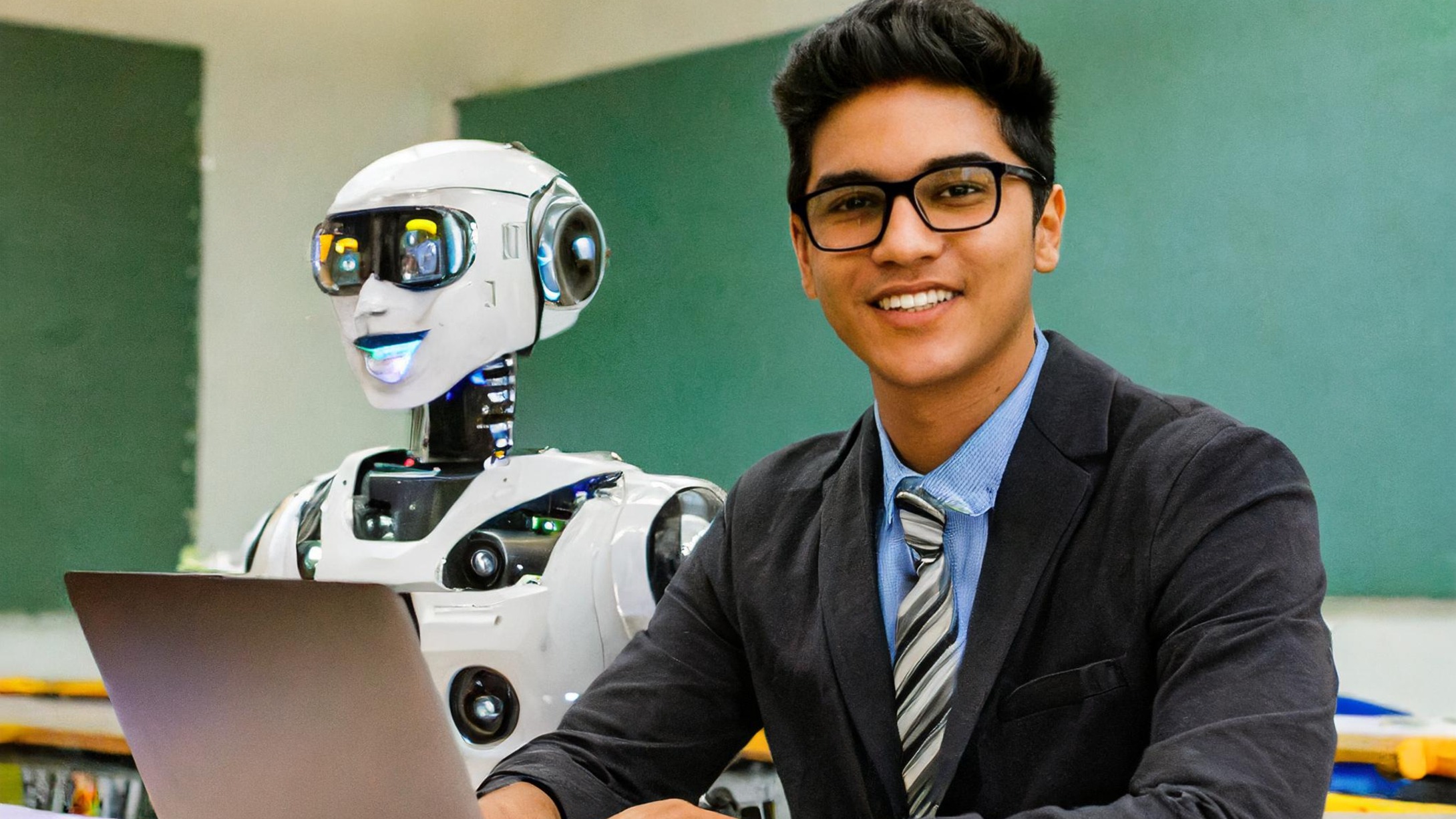
AI isn't the real threat — the skills gap is. About 40% of job skills will need to change by 2030. While we need technical AI skills, human traits like creative thinking, resilience, and agility are more valuable than ever.
“Will AI take our jobs?” “How dangerous is AI going to be for the human workforce?” “Have you heard the news? Company XYZ just sacked 5,000 people because of AI.”
We hear these whispers everywhere — at coffee shops, on LinkedIn, and in the news. But how much of this is reality, and how much is just “fear-mongering” born from a half-cooked understanding of Artificial Intelligence? To find out, we must look past the scary headlines and understand the math and history behind the machine.
What is Artificial Intelligence?
Before we debate if AI is a threat, we need to know what it is. Simply put, Artificial Intelligence (AI) is a branch of computer science that builds machines capable of simulating human intelligence—learning from experience, reasoning through problems, and making decisions.
According to IBM, AI enables machines to simulate human comprehension, creativity, and autonomy. Think of it as a set of tools that allows a computer to understand your language, analyse massive amounts of data, and give you helpful suggestions in a way that used to require a human brain.
The 70-Year Journey of the “Neural Network”
AI didn't just appear last year; it has been evolving for over seven decades. The “magic” happens through Machine Learning, where we train algorithms to make decisions based on data. The most famous version is the Neural Network, which is modelled after the human brain’s structure.
Mathematically, these networks learn through an optimisation process called Gradient Descent. When the AI makes an error, it uses this formula to adjust its internal "weights" (w) to get closer to the truth: wt+1= wt − η∇J(wt)
By repeating this millions of times, the machine “learns”. This journey followed a clear timeline:
- The Seeds of AI (1940s–1950s)
- The Birth of a Field (1956)
- Early Success & Challenges (1960s–1970s)
- Revival & Growth (1980s–2000s)
- The Modern AI Boom (2010s–present)
Why We Fight the New: The "Brick Phone" Lesson
As humans, we are wired to resist change. In his book Innovation and its Enemies, Prof. Calestous Juma of Harvard explains that we often fear new things because they threaten the “status quo” or our sense of power. He uses the “brick phone” as a perfect example. In 1983, Motorola’s first cell phone cost $4,000 (about $13,000 today), weighed two pounds, and died after just 30 minutes of talk time. People mocked them as useless toys for the rich.
However, when the cell phones reached Africa, they were reinvented. In Kenya, entrepreneurs used them to pioneer mobile money transfers because traditional banks were too slow to adapt. Today, those “bricks” have evolved into smartphones that serve as our banks, schools, and clinics.
India’s Tech Story: From Protests to Powerhouse
India’s relationship with computer technology hasn't always been easy. In 1963, the Life Insurance Corporation (LIC) installed its first computer—a primitive "data processor."
The reaction? National protests. Between 1967 and 1969, the “anti-automation movement” reached its peak because people feared the machine would steal their livelihoods. This fear caused India to miss early opportunities to modernise its economy.
The contrast today is staggering. The Indian IT workforce now exceeds 5.8 million professionals. The industry is set to hit US$ 350 billion by 2026, making up 10% of India’s GDP. The very technology people once protested is now the engine of the Indian middle class.
AI: Friend or Foe? (The Math of Jobs)
Is the fear real? Partly. Goldman Sachs predicts AI could replace 300 million full-time jobs. But there is another side to the ledger. According to the World Economic Forum’s Future of Jobs Report 2025, we can calculate the Net Employment Change (ΔE): ΔE= Enew − Edisplaced
- Enew (New Roles Created): 170 million
- Edisplaced (Roles Replaced): 92 million
- ΔE (Net Increase): 78 million jobs
The math shows that AI isn't the real threat — the skills gap is. About 40% of job skills will need to change by 2030. While we need technical AI skills, human traits like creative thinking, resilience, and agility are more valuable than ever. We don't need to fear the machine; we need to upskill the human.
India & AI: The Next Romantic Chapter
India has a long-standing “romance” with computer science. AI is expected to add $957 billion to the Indian economy by 2035. We are looking at an incredible growth rate (CAGR) of 38.1%:
Where AI is already winning in India:
- Agriculture: Tools are boosting crop yields by up to 30% in states like Andhra Pradesh
- Healthcare: Early detection of TB and cancer
- Public Services: The BHASHINI project uses AI to break down language barriers across the country
- Talent: India provides 19.9% of all global GitHub AI projects.
The Bottom Line
AI is not a threat to those who are willing to learn. The real danger is an education system stuck in “mugging up” subjects instead of teaching critical thinking. From the farmer in Maharashtra to the student in Delhi, the goal is “AI for All”.
History shows us that every time we feared a machine, we ended up using it to build a better world. It’s time to stop worrying about the 5,000 jobs lost and start preparing for the 78 million jobs waiting to be created.
The authors are Founders, Ingenium Digitus Amicita. Views expressed are personal.
Terms Explained; sources cited
- Neural Networks: A computational model inspired by the structure of the human brain. It consists of layers of "nodes" that process information, making it highly effective at recognising complex patterns in large datasets.
- Gradient Descent: The mathematical optimisation algorithm used to train AI. It calculates how to adjust the model's internal parameters (weights) to minimise the error between its prediction and the actual truth.
- Net Employment Change (ΔE): The difference between the number of jobs created by new technology and the number of jobs displaced by it.
- Juma, C. (2016). Innovation and Its Enemies: Why People Resist New Technologies. Oxford University Press. (Source for the "brick phone" analogy and the psychology of resistance).
- Sukumar, A. M. (2019). Midnight’s Machines: A Political History of Technology in India. Penguin Random House India. (Source for the 1960s "anti-automation movement" and LIC computer protests).
- NASSCOM & MeitY (2024). The State of AI in India: Driving the IndiaAI Mission. (Source for the $957 billion economic impact and 38.1% CAGR projections).