 |
| |
SAMACHAR - NOVEMBER, 2025 |
|
|
| |
| |
|
NABARD and IAMAI Jointly Launch Unique Annual Summit on Empowering Rural
Innovation
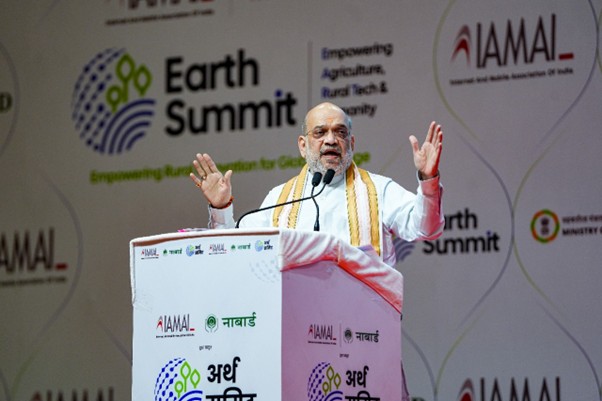
Shri Amit Shah, Hon’ble Union Home Minister,
addressing Earth Summit, Gandhinagar
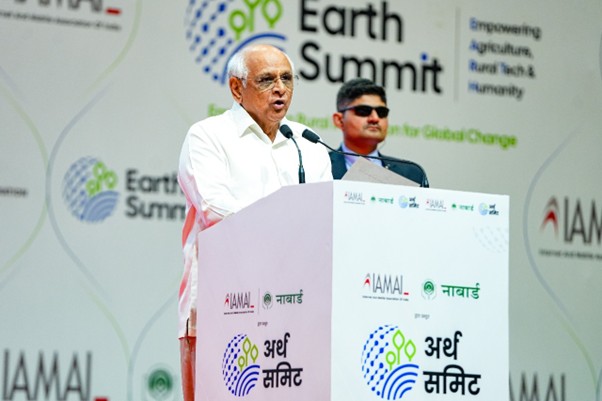
Shri Bhupendrabhai Patel, the Hon’ble Chief
Minister of Gujarat, addressing Earth Summit, Gandhinagar
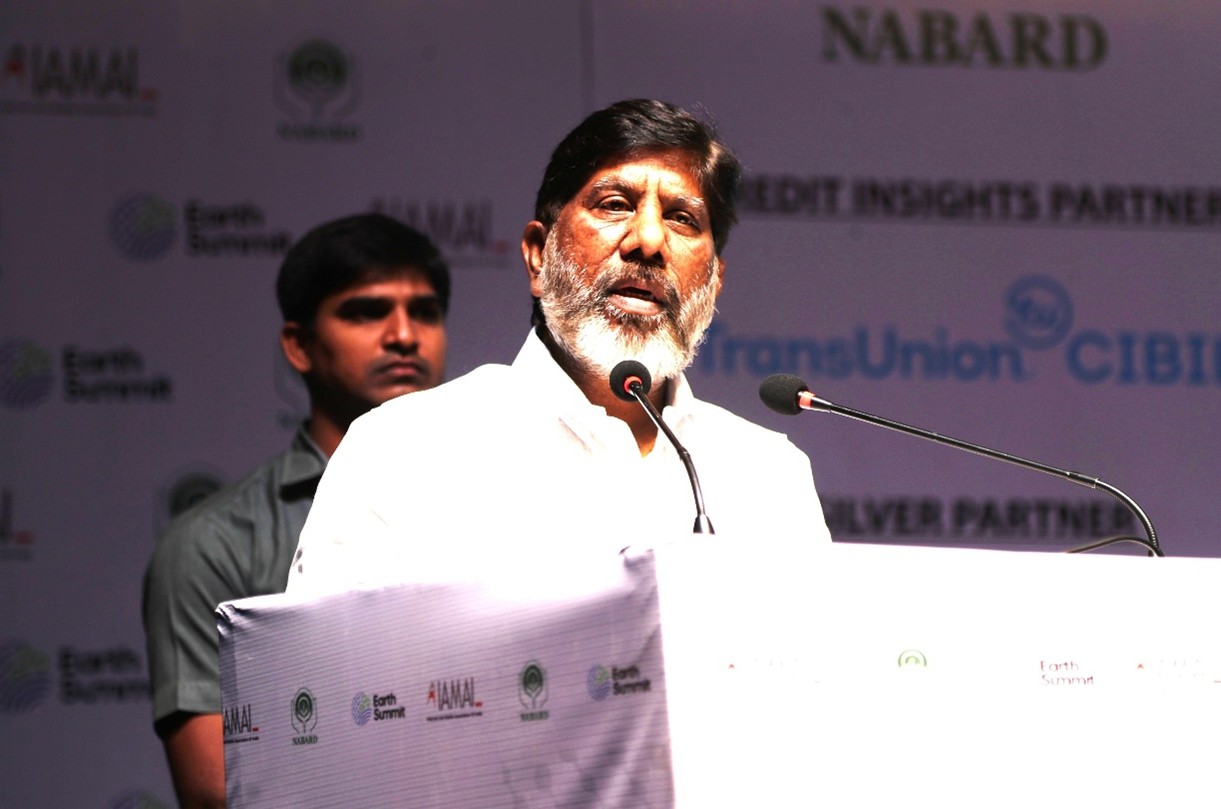
Shri Bhatti Vikramarka Mallu, Hon'ble Deputy
Chief Minister of Telangana, addressing Earth Summit, Hyderabad
The Internet and Mobile Association of India (IAMAI) in collaboration with the
National Bank for Agriculture and Rural Development (NABARD) has launched the
inaugural edition of a unique annual summit, titled the Earth Summit, themed on
“Empowering Rural Innovation for Global Change”. The inaugural,
2025-26 edition, of the Earth Summit comprises three separate conferences in
Hyderabad, Gandhinagar and New Delhi, being organized, between November 2025 and
February 2026.
While the Hyderabad chapter of the Earth Summit 2025-26 took place at the HITEX
Exhibition Centre on November 20 and 21, 2025, the Gandhinagar chapter was
organised on December 5 and 6, 2025, at the Mahatma Mandir Convention &
Exhibition Centre.
Among the high points of the first two chapters of Earth Summit 2025-26 were the
inaugural address by the Hon’ble Union Home Minister, Shri Amit Shah, and
the address by the Guest of Honour, Shri Bhupendrabhai Patel,
the Hon’ble Chief Minister of Gujarat, at Gandhinagar, and the address by
The Hon'ble Deputy Chief Minister of Telangana, Shri Bhatti Vikramarka Mallu, at
Hyderabad.
After Inaugurating the Gandhinagar conference, Shri Shah launched Sahakar
Sarathi Private Limited, a pioneering shared-services technology platform aimed
at transforming the rural cooperative banking ecosystem. Shri Shah also released
the NABARD–BCG report, The Future of Rural Banking.
Shri Shankarbhai Lagdhirbhai Chaudhary, Hon’ble Speaker, Gujarat
Legislative Assembly; Shri Jethabhai Ghelabhai Ahir, Hon’ble Deputy
Speaker, Gujarat Legislative Assembly; Dr Ashish Kumar Bhutani, Secretary,
Ministry of Cooperation, Government of India; Dr. Anju Sharma, Additional Chief
Secretary - Agriculture, Farmers Welfare & Co-operation Department,
Government of Gujarat, and Mr Ajay Bhai Patel, Chairman, Gujarat StCB, were
among other dignitaries who participated I the Gandhinagar conference.
Among dignitaries who addressed the Hyderabad conference were Shri Jayesh
Ranjan, Special Chief Secretary, Chief Minister’s Office, Special Projects
(SPEED), Investment & Industry Cell, Government of Telangana; Shri Vivek
Bharadwaj, Secretary, Ministry of Panchayati Raj, Government of India, and Mr.
Shaji KV, Chairman, NABARD.
Both the conferences drew participation from policymakers, corporates, fintechs,
technology leaders, and startups among others. A major attraction at both events
was the expo zone.
|
|
|
|
|
 |
| |
|
RBI Recognises SRPA as SRO for PSOs
|
The Self-Regulated PSO Association (SRPA) was recognised by the Reserve Bank of
India as an SRO for Payment System Operators (PSOs) in November 2025. The
recognition follows the RBI’s Framework for Recognition of Self-Regulatory
Organisations (SRO) for Payment System Operators issued in October 2020, and the
Omnibus Framework for Recognition of SROs for Regulated Entities of the Reserve
Bank issued in March 2024. The SRPA represents the collective commitment of
India’s leading payment system operators to foster a safe, secure, and
compliant digital payments ecosystem under a collaborative co-regulatory model.
|
|
|
|
|
|
| |
|
Submission on Draft Amendments to the IT Rules 2021
| The Internet and Mobile Association of India (IAMAI) submitted its
comments to the Ministry of Electronics and Information Technology (MeitY) on the
Draft Amendments to the Information Technology (Intermediary Guidelines and
Digital Media Ethics Code) Rules, 2021. In its submission, the IAMAI noted that
the proposed definition of SGI was overly broad and could have wide ranging
effects across the digital space. IAMAI also pointed out that existing legal
framework already provided sufficient safeguards to curb unlawful activities and
was in line with MeitY’s own recently released India AI Governance
Guidelines. |
|
|
|
|
|
| |
|
Submission to MoEFCC Seeks Policy Clarification and Ease of Doing Business
Measures with Respect to Compostable Plastics
|
The IAMAI made a submission to the Ministry of Environment, Forest
& Climate Change (MoEFCC) regarding the use of compostable and biodegradable
plastics. The submission noted that, although the Plastic Waste Management Rules
allowed compostable and biodegradable plastics certified by the Central
Pollution Control Board (CPCB), enforcement agencies often misidentified these
products as banned single-use plastics during compliance inspections. Such
misinterpretation has resulted in compliant businesses facing penalties, product
seizures, financial losses, and reputational harm despite adhering to CPCB
certification and regulatory requirements. The IAMAI requested a formal
clarification to ensure uniform interpretation and enforcement of the Rules
across jurisdictions and recommended the use of CPCB’s online database of
certified compostable plastic manufacturers for real-time verification.
Alternatively, IAMAI suggested, the Ministry could host a publicly accessible
verification list to support enforcement authorities and industry stakeholders.
|
|
|
|
|
|
| |
|
Submission on Draft Telecommunication (Authorisation for Telecommunication
Network) Rules, 2025
|
The IAMAI submitted its recommendations to the Department of
Telecommunications (DoT) on the Draft Telecommunications (Authorisation for
Telecommunication Network) Rules, 2025. The submission highlighted the need to
broaden the scope of DCIP and IP-1 authorisations to account for modern data
centre and cloud interconnectivity requirements. The IAMAI further noted that
the Draft Rules prohibited Indefeasible Rights of Use (IRU) arrangements between
two authorised entities, including IP providers, which did not reflect current
digital infrastructure realities. As India transitions to cloud-led networks and
edge computing, the inability of IP entities to enter IRU agreements limits
infrastructure sharing, scalability, and rapid, cost-efficient expansion. The
submission also emphasized that restricting Telecom Service Providers (TSPs) to
work only with Cloud Service Providers (CSPs) holding CTN authorisation would
reduce competition, restrict access to global best-in-class cloud
infrastructure, and slow down virtualisation of core network functions. The
IAMAI further pointed out that ‘Cloud Computing was not a telecom service
rather it was an IT service that fell squarely within the jurisdiction of MeitY,
which oversaw CSPs through its ‘MeghRaj’ cloud initiative.
|
|
|
|
|
|
| |
|
Submission on CERT-In Comprehensive Cyber Security Audit Policy
Guidelines
|
The IAMAI submitted a compilation of member queries to CERT-In on
the Comprehensive Cyber Security Audit Policy Guidelines, seeking clarity on
audit scope and implementation. The submission asked whether companies already
undergoing annual audits by globally accredited firms can use existing reports
instead of commissioning separate audits from CERT-In empanelled auditors. It
also proposed allowing a pooled audit model for shared cloud platforms to avoid
duplication. The IAMAI raised concerns about requiring a static Software Bill of
Materials for dynamic SaaS environments and sought clarity on audit initiation
timelines and the categories of private entities currently covered or expected
to be brought under the Guidelines.
|
|
|
|
|
|
| |
|
Submission to the MeitY on Draft Promotion and Regulation of Online Gaming Rules
2025
The IAMAI made a submission to the Ministry of Electronics and
Information Technology (MeitY) on the Draft Promotion and Regulation of Online
Gaming Rules 2025 (Draft Rules). In its submission, the IAMAI requested MeitY to
provide clarity on various aspects of the Draft Rules such as the jurisdiction
of the designated authority (Authority), scope of online gaming service
providers, and recognition threshold of e-sports and reporting mechanisms to the
Authority. IAMAI recommended that the scope of online game service provider
should be narrowed down so that it did not bring under regulation and compliance
such entities that merely provided distribution or access infrastructure to
games.
The IAMAI recommended that the obligation of registered e-sports and online
social games’ players to report any material change to the Authority,
should not extend to any modification of features in an online game and clarity
should be provided regarding the timing, form, or threshold for such intimation.
It highlighted the lack of clarity on whether the recognition of e-sports by the
Authority would be conducted on a game-to-game basis or for the entire industry
of e-sports altogether. It was suggested that the criteria for e-sports to be a
game of ‘pure skill’ be removed as it is difficult to develop a game
which is determined solely by skill.
The IAMAI further pointed out that the jurisdiction of the designated Authority
could potentially conflict with the jurisdiction of the Reserve Bank of India
(RBI).
|
|
|
|
|
|
| |
|
Submission to Ministry of Health and Family Welfare on the Draft Drugs &
Cosmetics (Amendment) Rules, 2025
|
The HealthTech Committee of the IAMAI made a submission to the Ministry of
Health and Family Welfare on the Draft Drugs & Cosmetics (Amendment) Rules,
2025. The draft amendment rules seek to introduce provisions on debarment of
such prospective licensees in the health tech sector, that submit false or
fabricated documents during the license application process. IAMAI's submission
welcomed the draft amendment rules and suggested certain changes to better
define the scope of the debarment provisions, inclusion of principals of natural
justice into the process, and highlighted need for more precisely defined terms.
|
|
|
|
|
|
| |
|
Submission to DFS on Draft Rules Online Gaming Act, 2025
|
The IAMAI’s Payments Council of India (PCI) made a submission to the
Department of Financial Services (DFS), Government of India, outlining the
industry’s key concerns with the Draft Online Gaming Act, 2025, and the
Draft Rules issued by MeitY. The submission emphasized the need for a verified,
centralised, and periodically updated repository of prohibited and registered
merchants. The submission underlined that such a list was crucial to ensure
consistent compliance and enforcement across issuers, acquirers, and other
payment ecosystem participants among other suggestions.
|
|
|
|
|
|
| |
|
Submission to DFS on India–Canada Finance Ministers’ Dialogue 2025
|
The PCI made a submission to the Department of Financial Services (DFS),
Government of India, containing industry suggestions on the inaugural
India–Canada Finance Ministers’ Dialogue. The submission contains inputs
on financial innovation, digital public infrastructure, cross-border payments,
and fintech investment. The PCI recommended a structured corridor programme
focusing on cross-border payments, fintech cooperation, data governance, and
regulatory innovation, aligned to the G20’s cross-border payments roadmap.
The suggestions aim, to enhance the cooperation, policy priorities, and pilot
ideas that can advance the India–Canada partnership in fintech and digital
finance.
|
|
|
|
|
|
| |
|
Submission to RBI Requesting Clarifications on PA Master Directions
|
The PCI made a submission to the Reserve Bank of India (RBI) highlighting key
operational and compliance challenges. As stakeholders begin transitioning to
the new directions, varying interpretations of certain provisions have emerged,
necessitating regulatory clarity to ensure consistent implementation across PAs,
banks, and ecosystem participants. Based on multiple member consultations, the
PCI has consolidated the key issues regarding which clarification was required
and has sought guidance from the RBI.
|
|
|
|
|
|
| |
|
Submission to RBI on Extending Access to Commercial Credit Reports to
NSUs
|
The IAMAI’s Fintech Convergence Council (FCC) made a submission to the
Reserve Bank of India (RBI) on November 25, 2025, requesting expansions on the
NSU access to include commercial credit reports. The submission highlights
operational challenges faced by MSMEs under the current framework, which
restrict NSUs to individual credit reports. The submission proposed a
consent-driven, safeguard-based mechanism that enabled legal entities to access
their own commercial credit reports to improve credit awareness, portfolio
monitoring, and digital lending workflows.
|
|
|
|
|
|
| |
|
Submission to DEA in Support of Regulation of Digital Gold in India
|
The FCC, along with key members of the Digital Gold ecosystem, on November 24,
2025, made a submission to the Department of Economic Affairs, Ministry of
Finance, Government of India, expressing support to the initiative of
establishing a regulatory framework for Digital Gold in India. The FCC continues
to work with industry participants to advance structural reforms for building a
secure and sustainable Digital Gold ecosystem.
|
|
|
|
|
|
| |
|
Submission to AMFI and SEBI on Continuity and Structured Transition in API-based
Data Access Through MFCentral-CAS
|
The FCC submitted industry recommendations to the Association of Mutual Funds
of India (AMFI) and the SEBI on ensuring continuity and a structured transition
for API-based data access through MFCentral CAS (Consolidated Account
Statement).
|
|
|
|
|
|
| |
|
FCC Seeks Clarity on Applicability of SEBI’s Direction on Valid UPI Handles for
SEBI Registered Entities
|
The FCC engaged with the Securities and Exchange Board of India (SEBI) to seek
clarity on the applicability of SEBI’s circular on valid UPI handles to
SEBI-registered entities operating as Payment Aggregators (PA). SEBI’s
response confirmed that pooling funds into PA escrow accounts was permissible
for such entities, easing implementation requirements under the circular.
|
|
|
|
|
|
| |
|
FCC Seeks AMF Guidance on Implementation of SEBI Guidelines for Adoption of
Valid UPI Handles by Mutual Fund Distributors
|
The FCC on November 26, 2025, sought guidance from the Association of Mutual
Funds of India (AMFI) on a uniform regulatory pathway enabling Mutual Fund
Distributors undergoing a change in legal identity to obtain a valid,
platform-level UPI handle for seamless investor payment flows across multiple
Asset Management Companies (AMCs).
|
|
|
|
|
|
| |
|
Legal Tech Committee Hosts Networking Evening for In-House Counsels, Law Firm
Partners, and Business Leaders
The IAMAI’s LegalTech Committee hosted a closed-door
networking evening for leading in-house counsels, law firm partners and
business leaders on November 28, 2025, at the India Habitat Centre,
New Delhi. The session fostered meaningful dialogue on operationalising the
Digital Personal Data Protection (DPDP) Rules, emerging AI frameworks, and
platform governance, central to India’s rapidly evolving digital legal
landscape.
The evening opened with insights from Mr. Amitabh Lal Das, Chief Legal Officer,
Hyundai Motor India Ltd, followed by two dynamic panel discussions. Industry
leaders from top firms such as AZB & Partners, Poovayya Advocates, Dentons
Link Legal, Saraf & Partners and Bharucha & Partners along with senior
legal in-house counsels from Mastercard and IDfy, shared perspectives on
data privacy, intermediary liabilities, and AI compliance challenges.
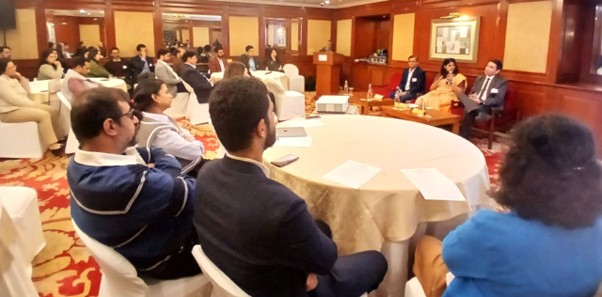
A panel discussion at the Legal Tech Committee
Networking Evening
|
|
|
|
|
|
| |
|
Digital Advertising Council Convenes Measurement Working Group Meeting
The IAMAI’s Digital Advertising Council convened a meeting of the
Measurement Working Group on 5th November 2025 at Interactive
Avenues, Mumbai, with participation from Google, Meta, NDTV, TAM Media
Research, InShorts, Frodo, and Interactive Avenues. The group discussed the
roadmap for creating a standardized, credible, and representative digital
measurement ecosystem in India. There was a consensus that advertiser
centricity should drive the framework, focusing on delivering value and
actionable insights to advertisers and agencies. Members agreed that while media
planning systems were robust, the real opportunity lay in better
post-evaluation and performance benchmarking.
It was agreed that digital video would serve as the starting point for
developing a common currency, given its scale and growth. The group
emphasized that measurement should be robust, representative, and consistent,
capturing India’s 800 million+ digital users, and potentially evolving
into a large-scale panel-based system.
|
|
|
|
|
|
| |
|
PCI-FCC Host Closed-Door Interaction Between Industry Leaders and ADGM
CEO
|
The PCI and the FCC hosted a closed-door interaction of select industry leaders
with H.E. Rashed Abdulkarim Al Blooshi, CEO, Abu Dhabi Global Market (ADGM)
Registration Authority. The discussion focused on operational and regulatory
challenges faced by the industry, with an aim to provide further insights that
will help facilitate a more supportive and enabling fintech and payments
ecosystem.
|
|
|
|
|
|
| |
|
PCI-FCC Annual Convene Annual Member Meet
|
The Payments Council of India (PCI) and the Fintech Convergence Council (FCC)
convened their Annual Member Meet for 2024–25 on November 25, 2025. The meeting
provided an overview of key initiatives and milestones achieved by both councils
during the past financial year. Members were apprised of major policy
engagements, industry advocacy efforts, and collaborative programs undertaken
across the ecosystem. The meeting concluded with a discussion on strategic
priorities and the planned roadmap for the upcoming year.
|
|
|
|
|
|
| |
|
PCI’s PPI Committee Holds Quarterly Meeting
|
The PCI’s Prepaid Payment Instrument (PPI) Committee convened its
quarterly meeting on November 14, 2025, to review ongoing regulatory submissions
and outline the focus areas for the upcoming quarter. Members highlighted the
need for greater flexibility in periodic KYC update requirements, smoother
UPI–PPI interoperability, and improved discoverability of PPIs on TPAPs. The
meeting also covered other issues such as enabling limited-value payments for
Minimum-KYC PPIs.
|
|
|
|
|
|
| |
|
Webinar on the Applicability of the DPDP Act, 2023 on the Indian Digital Gaming
Sector
|
The IAMAI hosted an informative webinar on the interplay and
applicability of the DPDP Act on the digital gaming sector in India,
specifically online social games and e-sports, titled ‘Data Protection in
Indian Gaming Sector: Navigating Consent, Profiling & Player Privacy Under
the DPDP Act’. The legal experts who addressed the webinar were Ms.
Ranjana Adhikari, Partner, Shardul Amarchand Mangaldas and Mr. Sarthak Doshi,
Principal Associate, Shardul Amarchand Mangaldas. The webinar focussed on how
gaming companies must attune their data governance practices as per the recently
enforced Digital Personal Data Protection Act, 2023 and the rules therein (DPDP
Act).
|
|
|
|
|
|
| |
|
Webinar on the Applicability of the DPDP Act on the Healthtech Sector
|
The IAMAI organised an informative webinar, titled ‘Ensuring
Patient Data Protection in Health Tech Startups under DPDP’ exploring the
interplay and applicability of the DPDP Act on the health-tech
sector. The legal expert for the session was Mr.
Chirag Jain, Associate Partner, DSK Legal. The session focussed on the treatment
to sensitive personal data of patients by health-tech platforms and allied
compliances while maintaining patients’ confidentiality and keeping
necessary records.
|
|
|
|
|
|
| |
|
Webinar on the Applicability of the DPDP Act on the Indian TravelTech
Sector
|
The IAMAI organised a webinar on “Data Privacy and
Compliance for Online Travel Aggregators under the DPDP Act”. It explored
the interplay and applicability of the DPDP Act on the Indian TravelTech
sector. The legal expert for the
session was Ms. Minal Madan, Founding Partner, SLP Law. The webinar focused how
OTAs collected, stored, and processed traveller data, emphasizing best practices
in consent management and cross-platform data usage. Participants gained
insights into regulatory obligations under India’s DPDP Act, strategies
for compliance, and risk mitigation in handling sensitive traveller information.
|
|
|
|
|
|
| |
|
Knowledge Session on Implications of DPDP Rules for India’s Digital Payments and
Fintech Sectors
|
Two councils of the IAMAI, the Payments Council of India (PCI) and the Fintech
Convergence Council (FCC), in collaboration with Khaitan & Co, organised a
webinar on the recently notified DPDP Rules. The session was addressed by Mr.
Supratim Chakraborty (Partner), Ms. Smita Jha (Partner) and Mr. Prashanth Ramdas
(Partner) at Khaitan & Co. The session provided members with a detailed
overview of the regulatory requirements, compliance considerations, and
practical implications for the digital payments and fintech ecosystem.
|
|
|
|
|
|
| |
|
RBIH–FCC Awareness Campaign on Fintech Repository
|
IAMAI’s Fintech Convergence Council (FCC), in partnership with the
Reserve Bank Innovation Hub (RBIH), continued its ongoing social media awareness
campaign to promote the FinTech Repository. The initiative, launched in October
2025, has steadily engaged stakeholders across the ecosystem, fostering greater
connectivity among fintechs, improving transparency, and strengthening
industry-wide collaboration.
|
|
|
|
|
|
| |
|
MCX–FCC Investor Awareness Campaign
|
The Fintech Convergence Council (FCC) and the MCX continued their joint
Investor Awareness Campaign, active since September 2025, engaging investors
nationwide. The November outreach focused on building awareness around
identifying and preventing fraudulent activities in the securities market.
|
|
|
|
|
|
| |
| |
|